
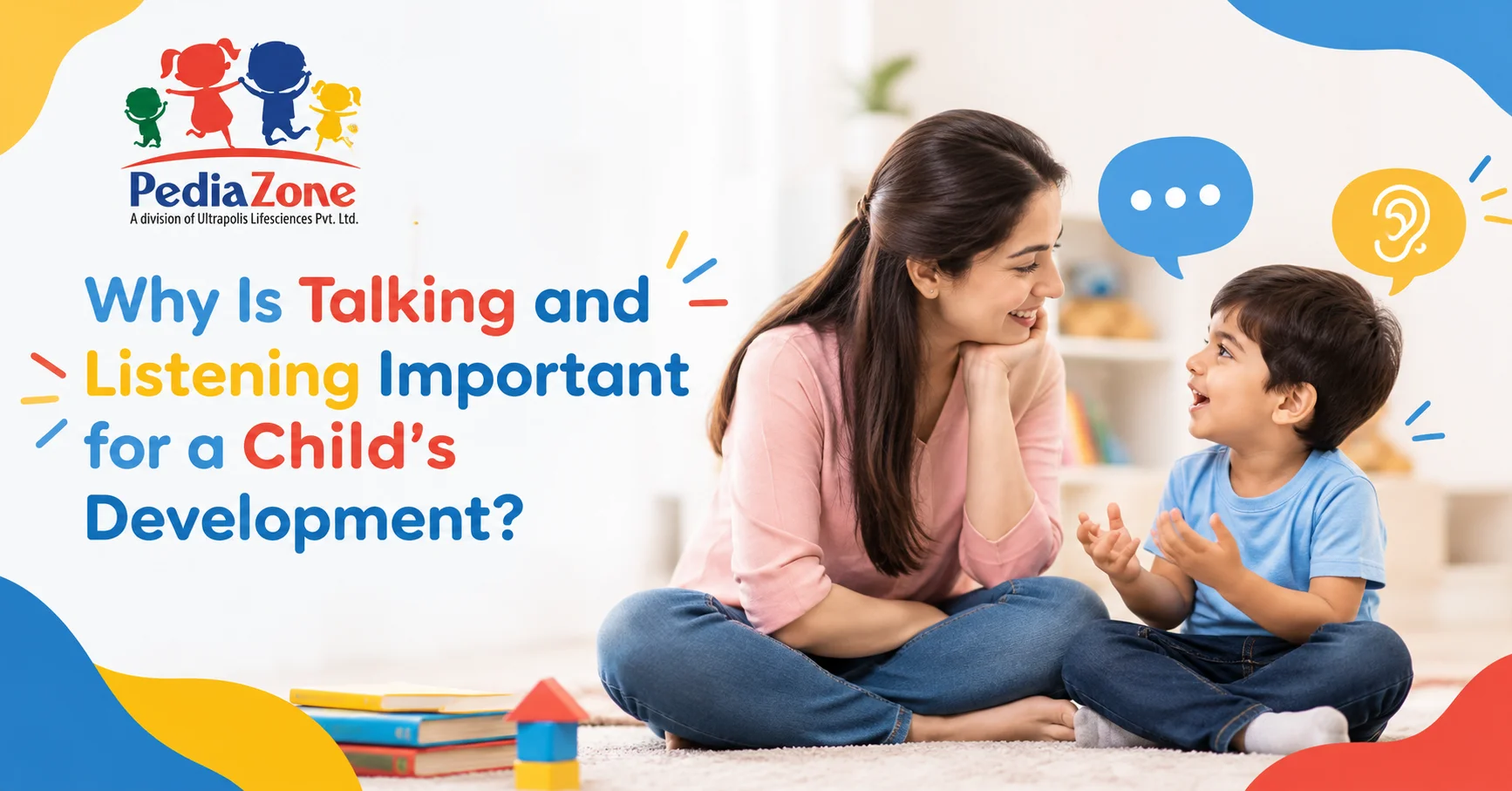
Why Is Talking and Listening Important for a Child’s Development?
When parents think about their child’s development, they often focus on food, sleep, school, physical growth, and activities. But there is another everyday habit that also matters: talking and listening.
A simple conversation during breakfast, a bedtime story, or a chat while walking home can give a child an opportunity to learn, communicate, and connect. Children learn from the people around them by listening to words, watching expressions, asking questions, and responding to what they hear.
The World Health Organization (WHO) and UNICEF recognise responsive caregiving and early learning as important parts of early childhood development. Responsive interaction includes noticing a child’s signals and responding to them through activities such as talking, playing, singing, and reading together.
So, how can everyday talking and listening support a child’s development?
How Does Talking Help a Child Learn?
Children learn language through regular interaction. They hear words repeatedly, learn how sentences are formed, and gradually understand how to use language themselves.
Parents can talk to children during ordinary activities. While preparing food, getting dressed, travelling, or going for a walk, parents can describe what they are doing or point out things around them.
For example, instead of simply saying, “Look at that,” a parent can say, “Look at that red bus. It is stopping near the school.”
This gives the child more words and ideas to understand.
Regular conversations also encourage children to express themselves. As they hear more language, they get more opportunities to practise using it.
Why Is Listening Just as Important?
Communication is not only about teaching children to speak. Children also need someone who listens to them.
When a child talks about their day, shares a story, or asks a question, giving them attention shows that their thoughts are worth hearing. It can also encourage them to communicate more openly.
Listening can help parents understand what a child is thinking and feeling. A child might not always say, “I am worried about school.” Instead, they might talk about something that happened in class or mention a small problem several times.
Patient listening can help parents notice these details.
Listening does not mean agreeing with everything a child says. It means giving them an opportunity to express themselves before responding.
Can Conversations Support Thinking and Learning?
Yes. Talking can do more than build vocabulary. Conversations can encourage children to remember, observe, compare, explain, and solve problems.
Parents can ask questions that encourage children to think rather than simply provide an answer.
For example:
“What do you think will happen next?”
“Why do you think the plant needs water?”
“How did you make that drawing?”
These questions encourage children to explain their ideas in their own words.
A conversation does not have to feel like a lesson. A discussion while cooking, travelling, playing, or looking at a picture book can become a natural learning opportunity.
WHO describes opportunities for early learning as interactions with people, places, and objects around a child. Responsive interactions can help enrich learning and support skills such as language and problem-solving.
How Can Talking and Listening Build Confidence?
Children need opportunities to express their thoughts without feeling that every sentence has to be perfect.
When parents listen patiently and respond positively, children get more comfortable sharing ideas. They can also learn from their mistakes without feeling discouraged.
For example, if a child uses an incorrect word or sentence, parents can gently model the correct form instead of stopping the conversation.
If a child says, “I goed to the park,” a parent could respond, “You went to the park? What did you do there?”
The conversation continues, while the child hears the correct form naturally.
This approach gives children space to communicate, learn, and try again.
Why Are Back-and-Forth Conversations Important?
A healthy conversation involves both speaking and listening.
A child speaks. The parent listens. The parent responds. The child responds again.
This back-and-forth interaction helps children practise taking turns, paying attention, understanding questions, and expressing their own thoughts.
For babies and younger children, communication begins even before they use words. Eye contact, facial expressions, sounds, gestures, and movements can all become part of interaction. Responding to these signals helps create early opportunities for communication and learning.
Parents can respond to a baby’s sounds, smile when the baby smiles, name an object the child is looking at, or imitate simple sounds. These small exchanges can become the beginning of meaningful communication.
What Can Parents Do at Different Ages?
The way parents communicate can change as children grow.
For babies and toddlers
Talk about what you are doing, name familiar objects, sing simple songs, look at picture books, and respond to sounds and gestures. Follow the child’s attention and talk about what they are looking at.
For preschool children
Ask questions about their games, stories, drawings, and daily experiences. Encourage them to describe what they see and what they think will happen next.
For school-age children
Talk about school, friendships, hobbies, books, and things they see around them. Ask for their opinions and give them opportunities to explain their ideas.
For older children
Conversations can become more detailed. Talk about their interests, experiences, challenges, and decisions. Listening without immediately judging or interrupting can help keep communication open.
The goal is not to have the same type of conversation at every age. It is to keep communication appropriate to the child’s stage of development.
Simple Ways to Encourage More Conversation
Parents do not need special equipment or a separate activity schedule. Everyday moments are enough.
Talk during daily routines: Describe what you are doing while cooking, getting ready, travelling, or shopping.
Ask open-ended questions: Instead of asking only questions that need a “yes” or “no,” ask children to explain or describe.
Read together: Talk about the pictures, characters, and events in a book. Ask what the child thinks might happen next.
Give them time to answer: Children sometimes need a few moments to organise their thoughts. Avoid completing every sentence for them.
Listen without rushing to correct: Not every conversation needs a correction. Sometimes children simply want to share something.
Reduce distractions: When possible, keep phones and other distractions aside during conversations so the child has your full attention.
Follow their interests: If a child is excited about insects, cars, animals, drawing, or space, use that interest to start a conversation.
Talking and Listening Are Everyday Learning Opportunities
A child does not need a complicated activity every day to support communication and learning. A few minutes of meaningful interaction can happen almost anywhere.
A question at breakfast, a story before bedtime, a conversation during a walk, or a discussion about a favourite toy can all give children opportunities to listen, think, speak, and respond.
WHO and UNICEF emphasise responsive caregiving and opportunities for early learning as important parts of nurturing care. These interactions can support children’s language, learning, social relationships, and overall development.
Most importantly, talking and listening help children feel connected to the people who care for them.
Because sometimes, an everyday conversation is more than just a conversation. It can be an opportunity for a child to learn, express, and grow.